


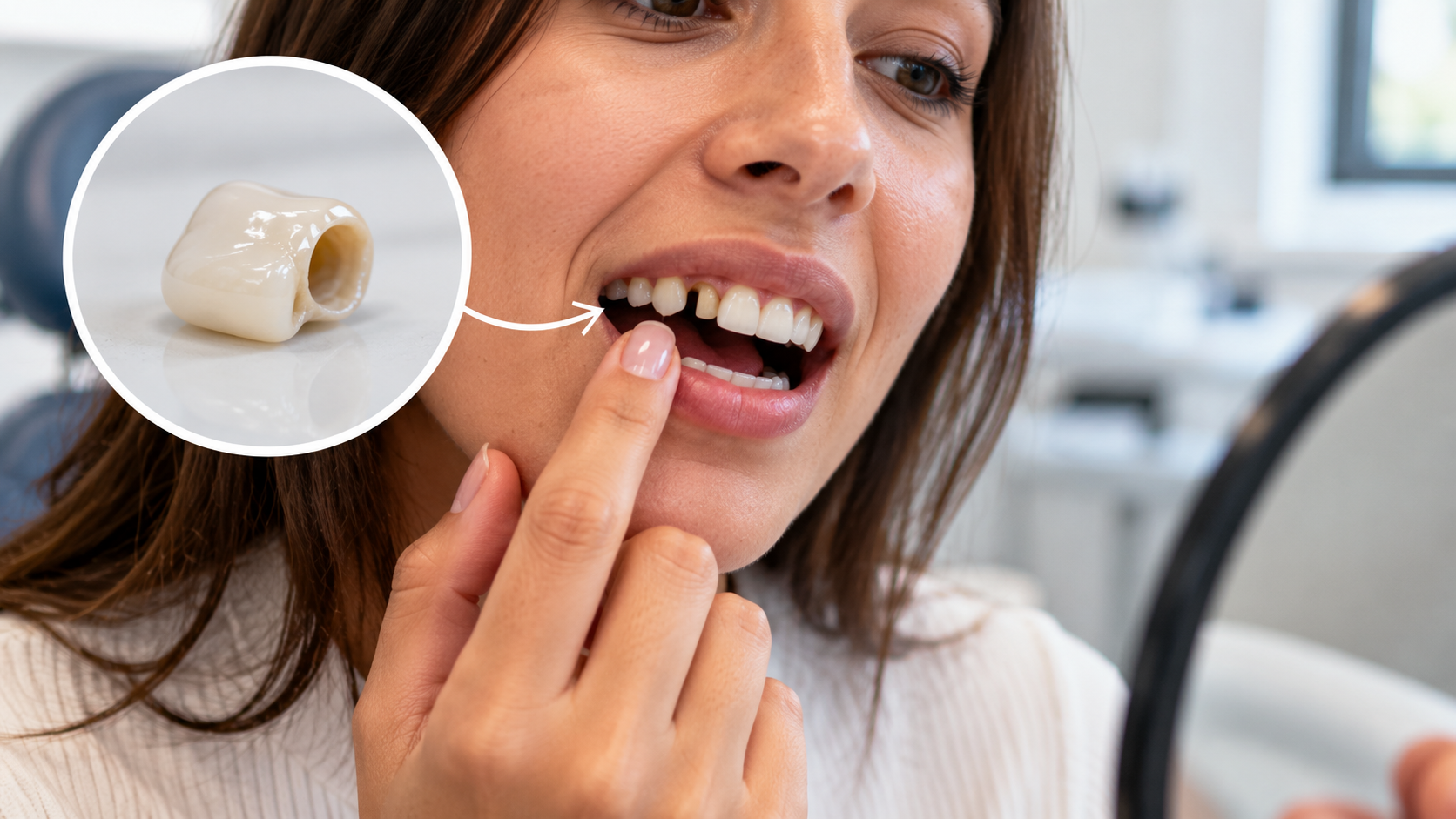

If your dental crown fell off, keep the crown, avoid chewing on the tooth and arrange a dental appointment promptly. The exposed tooth may be sensitive or weaker than usual, and the crown may no longer fit safely even if it appears undamaged. Do not use superglue or force it back into place.
Call G Dental in Greensborough on (03) 9435 6063 and tell us whether the tooth is painful, broken or swollen. Same-day appointments may be available within opening hours. Difficulty breathing or swallowing, rapidly spreading swelling or uncontrolled bleeding requires emergency medical care.
This guide will take you through the first few minutes, safe care while you wait and the reasons a crown can detach. We will then explain what we assess and when the crown can be recemented, repaired or replaced, so you understand why the appointment is more than simply “gluing it back on”.
What should I do first?
Find the crown if you can and handle it over a towel or container so it is not dropped. Rinse it gently with water; do not scrub the inside, and place it in a clean container. Look at the tooth without poking it.
Use the table below to choose the next action.
| What you notice | What to do | Urgency |
| Crown is off, tooth is intact and comfortable | Keep the crown, avoid chewing there and call | Prompt dental appointment |
| Tooth is sensitive to air, hot or cold | Protect it from temperature and call | Prompt appointment |
| Part of the tooth is inside the crown | Keep everything and do not refit it | Prompt assessment |
| Tooth is very painful, or gum is swollen | Use only suitable pain relief as directed and call | Same day where possible |
| Crown was swallowed, and breathing is normal | Contact your doctor or us for advice | Prompt advice |
| Coughing, choking or breathing difficulty followed detachment | Treat possible inhalation as an emergency | Call 000 |
Healthdirect’s dental crown information lists loosening, fracture, pain and a crown falling off among possible complications. The natural tooth underneath can still decay, which is one reason we need to examine it before recementing anything.
How should I protect the tooth while I wait?
Once the crown is stored safely, focus on keeping the area clean and avoiding further fracture.
- Brush gently with a soft toothbrush and fluoride toothpaste.
- Rinse with water after meals.
- Choose softer foods and chew on the other side.
- Avoid very hot, cold, hard and sticky foods.
- Keep the crown in a labelled clean container.
- Use pain medicine only if it is suitable for you and follow the label or professional advice.
- Call again if pain, swelling or bleeding increases.
Do not:
- use superglue, nail glue or craft adhesive
- scrape or drill the inside of the crown
- push the crown on if it does not seat easily
- sleep with a loose crown in your mouth
- place aspirin against the tooth or gum
- wait for weeks simply because there is no pain
Temporary dental cement from a pharmacy is sometimes discussed online. It does not make every crown safe to refit, particularly when tooth structure has broken or the bite prevents full seating. Call us before using it.
Why did my dental crown fall off?
The next step is finding out why the retention failed. A crown can detach because the cement released, decay changed the supporting tooth, the tooth or crown fractured, or repeated bite forces worked on the restoration.
The cement bond has failed
Dental cement can lose retention over time. If the crown and tooth remain sound, cleaning and recementing may be possible. We still check the fit, bite and reason it released rather than assuming fresh cement is enough.
Decay has developed under the crown
The crown material cannot decay, but tooth structure at or beneath its edge can. Decay may change the shape of the supporting tooth, leaving the crown without a stable fit.
You may not have felt pain. X-rays and examination may be needed to understand how much sound tooth remains and whether it can be restored.
The tooth or core has fractured
A heavily restored tooth may contain a filling or core beneath the crown. If part of that structure fractures, it may come away inside the crown. Do not pick it out, because it shows us what happened.
The depth and direction of the fracture affect whether the tooth can be rebuilt, needs root canal assessment or requires another plan.
The crown has cracked or worn
Porcelain, ceramic, metal or layered crowns behave differently, but all restorations can wear or fracture. A crack may be visible, or the crown may look intact until we inspect it closely.
Grinding, clenching or a heavy bite
Repeated force can loosen cement, fracture material or damage the supporting tooth. If the crown has come off more than once, we assess the bite and signs of grinding rather than recementing it indefinitely.
Sticky food or trauma was the final trigger
A sticky sweet may pull off a crown that had already lost retention. A knock can dislodge it and also injure the tooth. The last event matters, but it may not be the underlying cause.
When is a lost crown urgent?
A crown that comes off without pain generally needs prompt dental care, but not an ambulance. The situation becomes more urgent when the tooth has fractured, pain is severe, swelling develops, or the crown may have entered the airway.
Call us promptly for:
- increasing toothache or pain on biting
- facial or gum swelling
- fever, discharge or a bad taste
- bleeding around a broken tooth
- a sharp remaining edge cutting the tongue
- a crown on a front tooth after trauma
- difficulty eating because several restorations are involved
What happens at the appointment?
Bring the crown even if it is broken. We ask when it came off, whether the tooth was sensitive beforehand and whether you grind your teeth. We then examine the crown, tooth, gum and bite.
The assessment may include:
- Checking the crown for cracks, wear and fit.
- Examining the remaining tooth and any core material.
- Looking for decay, fracture or gum inflammation.
- Testing the tooth when symptoms suggest pulp or root involvement.
- Taking an X-ray where it will help answer a clinical question.
- Discussing recementation, repair, a new crown or another treatment.
We use local anaesthetic where clinically appropriate and discuss comfort before treatment. Sensations and treatment needs vary, so we explain what to expect after examining the tooth.
Can the same crown be put back on?
Sometimes. Recementation may be suitable when the crown is sound, the supporting tooth remains healthy, the margins fit, and the bite is acceptable. The crown must seat completely; forcing it over changed tooth structure can create a high bite or poor seal.
The likely options are:
| Finding | Possible plan |
| Crown and tooth are sound | Clean and recement where clinically appropriate |
| Small amount of supporting material is lost | Rebuild may be possible before recementation or a new crown |
| Decay changes the tooth shape | Remove decay and reassess restorability |
| Crown is cracked or no longer fits | A replacement crown may be discussed |
| Nerve or root problem is present | Root canal assessment may be needed before final restoration |
| Deep tooth fracture | Another restorative or tooth-replacement plan may be required |
No article can determine which row applies. The decision depends on examination, imaging where justified and your preferences.
What if it is a temporary crown?
A temporary crown protects the prepared tooth while the final restoration is made. If it comes off, call us rather than waiting for the permanent-crown appointment. The tooth may move, become sensitive or allow the gum to change shape, which can affect the final fit.
Keep the temporary crown and avoid sticky food. Do not use household glue. We may recement or replace it depending on condition and how soon the final crown is due.
If your bite feels high after a temporary crown is refitted, tell us. Continuing to bite heavily on it can make the tooth sore or dislodge it again.
Who may suit a new crown, and who may need another plan?
A new crown may suit a tooth with enough sound structure and healthy support when the old restoration is damaged or no longer fits. The material and design depend on tooth position, appearance, bite, remaining structure and other clinical factors.
A crown may not be the immediate next step where decay or gum disease needs treatment first, a crack extends too deeply, the tooth requires root canal therapy or there is not enough predictable support. In those situations, we discuss the available alternatives and their trade-offs.
Our dental crown service in Greensborough explains the general treatment stages. Suitability, timing and cost vary between people, and we provide a written plan after assessment.
What changes the cost?
Recementing an intact crown is different from rebuilding a tooth or making a replacement. The estimate may change with:
- whether decay or fracture is present
- the condition and material of the old crown
- how much sound tooth remains
- whether X-rays or root canal assessment are needed
- crown material and laboratory work
- temporary restoration needs
- bite management or a grinding splint
We do not quote one amount in this article because that could be incomplete or misleading. At the appointment, we explain what the proposed fee includes. HICAPS can process eligible claims from major health funds, subject to your policy.
How can I reduce the chance of recurrence?
After the crown is placed, protect the tooth and restoration with routine care.
- Brush twice daily with fluoride toothpaste.
- Clean between the crowned tooth and its neighbours every day.
- Avoid chewing ice and using teeth as tools.
- Wear a sports mouthguard where appropriate.
- Use a prescribed night guard if grinding has been diagnosed.
- Attend the review interval recommended for you.
- Report food trapping, movement, sensitivity or bite changes early.
The aim is to control the risks we can identify and catch changes while more options remain. Crowns and the teeth beneath them can still need treatment in the future.
Call our Greensborough practice
If your dental crown fell off, keep it safe and protect the tooth rather than trying to repair it yourself. The sooner we see it, the sooner we can tell whether the existing crown remains usable.
G Dental is at 137 Grimshaw Street, Greensborough. Give us a ring on (03) 9435 6063. We offer same-day appointments when available within our opening hours, including Thursday until 8:00 pm and every second Saturday. For a non-urgent enquiry, you can also use the website form.
Frequently asked questions
1. Can I put the crown back on myself?
Do not force it or use glue. Call us first because the tooth or crown may have changed, and an insecure crown can be swallowed or inhaled.
2. Can I eat without the crown?
Choose soft foods, chew on the other side, and avoid hot, cold, hard, or sticky items until the tooth is assessed.
3. Why does the tooth not hurt?
Some crowned teeth have had root canal treatment, while other problems develop without pain. The lack of pain does not confirm the tooth is healthy, or that the crown can simply be recemented.
4. What if I swallowed the crown?
If you are breathing normally, contact your doctor or us for advice. Coughing, choking, or breathing difficulty may indicate inhalation and requires emergency help.

