


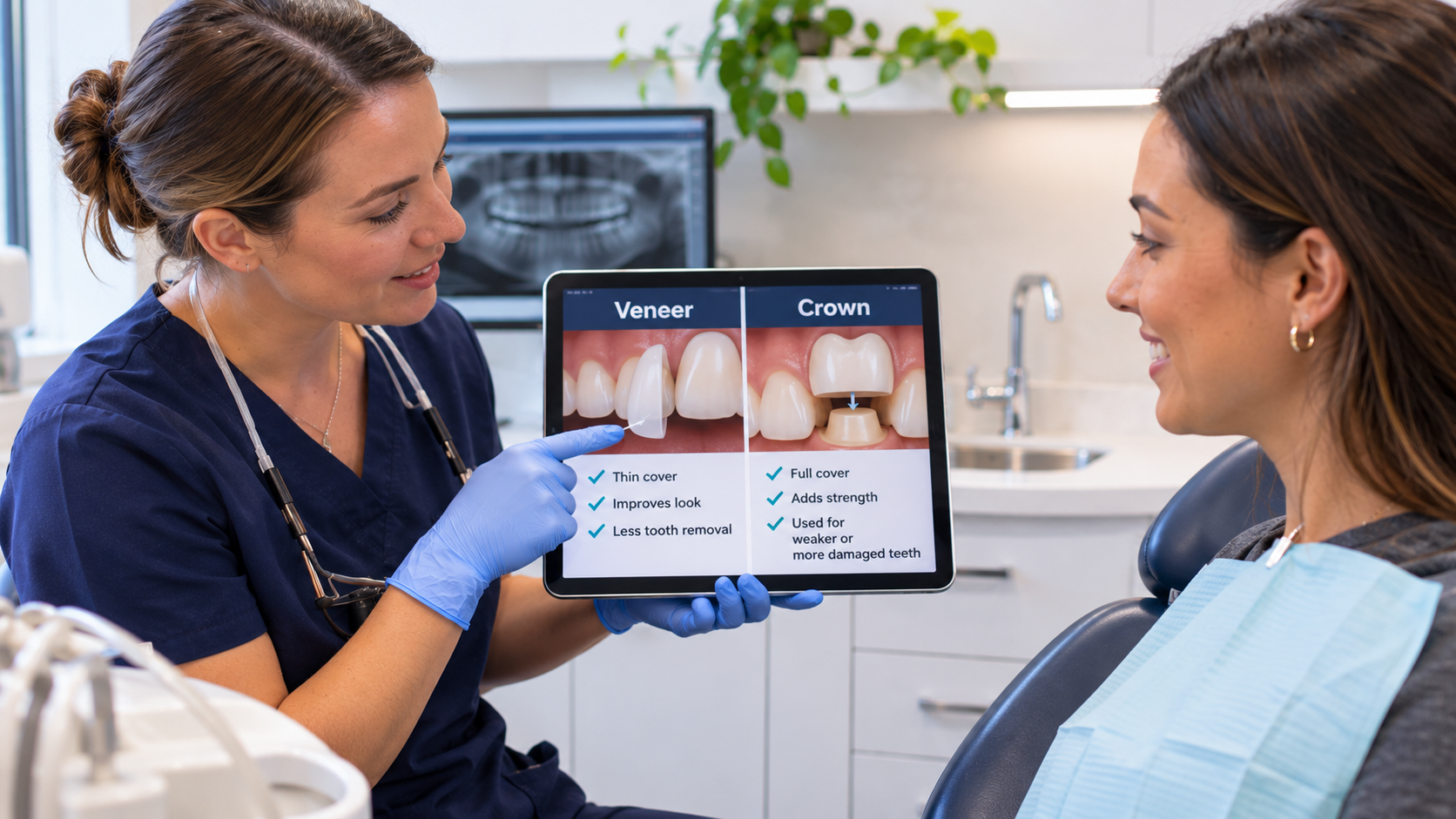

Veneers cover mainly the front surface of a tooth, while crowns cover most or all of the visible tooth above the gum. A veneer is generally considered for selected appearance changes where enough healthy tooth remains. A crown may be considered when a tooth needs broader structural coverage because it is heavily restored, cracked, weakened or has undergone other treatment.
When discussing veneers vs crowns, Greensborough patients should not choose from appearance alone. Both options require irreversible tooth preparation in many cases, both can need replacement over time, and sometimes neither is the most conservative answer. This guide explains suitability, preparation, risks, alternatives and the questions to bring to an assessment.
What is a dental veneer?
A veneer is a thin facing bonded to the front and sometimes edge of a tooth. Porcelain and composite resin are common materials, but they are made and placed differently.
Veneers may be considered for selected concerns involving:
- tooth shape or proportion
- discolouration that cannot be managed acceptably another way
- small gaps
- worn or chipped edges
- minor alignment appearance
- replacement of an existing unsuitable veneer
A veneer does not strengthen every damaged tooth, and it is not a substitute for treating decay, gum disease or a bite problem.
The Australian Dental Association provides consumer information about veneers, including the need to understand preparation, care and limitations before proceeding.
What is a dental crown?
A crown is a restoration that covers the visible portion of a prepared tooth. It may be made from ceramic, metal, a combination of materials or another suitable option.
A crown may be considered when a tooth:
- has a very large filling
- is cracked or structurally weakened
- has significant wear or loss of tooth tissue
- has had root canal treatment and needs cuspal protection
- requires a major change in shape as part of a wider plan
- already has a crown that needs replacement
Crowns still depend on the underlying tooth, root, gum and maintenance. Covering a tooth does not make it immune to decay at the margin or fracture.
Veneers and crowns at a glance
This comparison introduces the main differences. Individual preparation and material choices vary.
| Question | Veneer | Crown |
| Coverage | Mainly front surface and edge | Most or all visible tooth surfaces |
| Typical purpose | Selected appearance and minor form changes | Broader restoration and structural coverage |
| Tooth preparation | Often less extensive, but usually irreversible | Usually more extensive and irreversible |
| Suitable tooth | Adequate healthy enamel and structure | Weakened or heavily restored tooth in selected cases |
| Bite influence | Important | Important |
| Decay risk | Remains at margins and uncovered tooth | Remains at crown margin |
| Future care | Reviews, cleaning and possible replacement | Reviews, cleaning and possible replacement |
The more conservative option is not automatically a veneer. If it will not reliably address the tooth’s condition, another treatment may preserve more value over time.
How much tooth is prepared?
Preparation depends on the existing tooth, material, desired shape and bite. Veneers often require less reduction than crowns, but “no-prep” marketing should not be assumed to suit every person.
A bulky or over-contoured restoration can affect appearance and gum access. Sometimes a small amount of enamel preparation creates room for a natural contour. In other cases, alignment or whitening before restoration may reduce how much change the veneer must create.
A crown requires reduction around the tooth to provide space and a stable restoration shape. The dentist balances conservation with strength, retention and margin design.
When might a veneer be unsuitable?
A veneer may not be appropriate where there is insufficient enamel for predictable bonding, extensive decay, a large existing restoration, an unfavourable fracture, active gum disease or heavy uncontrolled bite forces.
Other concerns include:
- severe crowding or tooth position
- inadequate space for the intended material
- very short clinical crowns
- active grinding without a wider management plan
- unrealistic expectations about colour or symmetry
- unwillingness to maintain the restorations
Suitability is based on examination and records, not a photograph of the front teeth.
When might a crown be unnecessary?
A crown removes more tooth structure than a veneer or direct filling. It should not be recommended solely because the patient wants a colour change when less invasive options could meet the objective.
Depending on the diagnosis, alternatives may include:
- professional whitening
- direct composite bonding
- orthodontic alignment
- repair or replacement of a smaller filling
- monitoring
- a veneer rather than full coverage
- no treatment
We discuss alternatives even when they are not the option a patient first expected.
Porcelain veneers and composite veneers
The word “veneer” includes different materials and workflows.
| Feature | Porcelain veneer | Composite veneer |
| Manufacture | Usually made outside the mouth by a laboratory | Commonly shaped directly on the tooth |
| Appointments | Often staged with records, preparation and fitting | May be completed more directly in selected cases |
| Repair | Repair options depend on damage | Can sometimes be repaired directly |
| Staining and wear | Material-specific behaviour | More prone to staining and wear than ceramic in many situations |
| Preparation | Depends on tooth and plan | Depends on tooth and plan |
Our guide to composite veneer aftercare explains daily care and why reviews remain important.
What role does the bite play?
Front teeth guide biting and jaw movement. A veneer edge or crown can be exposed to repeated force if the bite is deep, edge-to-edge or affected by grinding.
We examine:
- where teeth contact when you close
- contacts during forward and side movement
- signs of wear or fracture
- missing back teeth and load distribution
- grinding or clenching history
- available space for restorative material
In some cases, orthodontic treatment before veneers or crowns creates better tooth positions and reduces the amount of restorative change required. That is a planning option, not a promise that alignment removes every risk.
How is colour selected?
Ceramic and composite can change tooth appearance, but material thickness, underlying tooth colour, neighbouring teeth and lighting all affect the result. Very opaque restorations may hide colour but look different from natural enamel.
If whitening is being considered, it is often discussed before selecting the final restoration shade because veneers and crowns do not whiten like natural teeth. Existing restorations may also need review if surrounding teeth change colour.
No dentist should promise an exact appearance from a screen image. Shade selection, photographs and laboratory communication support planning, but individual results vary.
What are the risks and limitations?
Possible considerations include:
- sensitivity after preparation
- gum irritation or recession
- chipping, fracture or debonding
- decay at restoration margins
- colour mismatch with changing natural teeth
- need for root canal treatment in some teeth
- wear of the opposing teeth
- repair or replacement over time
- dissatisfaction with irreversible changes
The risk profile differs between a minimally restored tooth and one already weakened by damage. Informed consent should address the proposed tooth, material and alternatives.
How long do veneers and crowns last?
There is no responsible lifetime promise. Longevity depends on material, tooth condition, preparation, bonding or cementation, bite, grinding, oral hygiene, diet, accidents and maintenance.
The useful question is how the restoration will be reviewed and what happens if it chips or reaches the end of service. Replacement can require further treatment, and this should be part of the first decision.
Looking after either restoration
Veneers and crowns require the same foundations as natural teeth: plaque removal, gum care and regular dental assessment.
A practical routine includes:
- brushing twice daily with a fluoride toothpaste as advised
- cleaning between teeth
- avoiding using teeth to open packaging or bite hard objects
- reporting chips, movement or bite changes
- attending examinations and professional cleaning
- using a prescribed protective appliance where appropriate
- limiting frequent sugar exposure
The Better Health Channel outlines general tooth and gum care. Your dentist may modify advice for the restoration and gum condition.
What changes the cost?
We do not insert unverified dollar figures into healthcare content. Cost can vary with the number of teeth, material, laboratory work, existing restorations, gum treatment, root canal needs, temporary restorations, bite management and whether alignment is completed first.
A written treatment plan should identify the proposed stages and alternatives. Comparing quotes is only meaningful when they include the same teeth, materials and associated care.
Questions to ask before deciding
For veneers vs crowns Greensborough consultations, ask:
- What diagnosis are we treating?
- How much tooth preparation is expected?
- Why is this option preferred over bonding, whitening or alignment?
- What material is proposed and why?
- How does my bite affect the restoration?
- What are the risks for this particular tooth?
- What maintenance is required?
- What happens if it chips or fails?
- Can I choose no treatment or defer it?
The answers should be specific to your mouth rather than a generic cosmetic package.
Compare the options in Greensborough
For veneers vs crowns, Greensborough patients need a diagnosis before selecting a material. G Dental is located at 137 Grimshaw Street, Greensborough.
Call us on (03) 9435 6063 or explore our information about porcelain veneers and dental crowns. We will explain the proposed preparation, alternatives, risks and ongoing care without pressuring you towards elective treatment.
Frequently asked questions
1. Is a crown stronger than a veneer?
A crown provides broader coverage, but “stronger” does not automatically mean more appropriate. Removing additional healthy tooth tissue without need is not conservative care.
2. Can a veneer go over a filling?
Sometimes, depending on the filling’s size, position and condition and the enamel available for bonding. Large restorations may change the recommendation.
3. Do crowns and veneers stain?
Materials behave differently, and surface staining can occur. Natural teeth around restorations may change colour differently. Professional assessment is safer than abrasive home treatment.
4. Are veneers reversible?
When tooth preparation is performed, treatment is generally irreversible. Even minimal-preparation cases require clear discussion of long-term commitment.
5. Can I have one veneer?
Sometimes. Shape and shade must be coordinated with neighbouring teeth, which can make a single front restoration demanding.

