


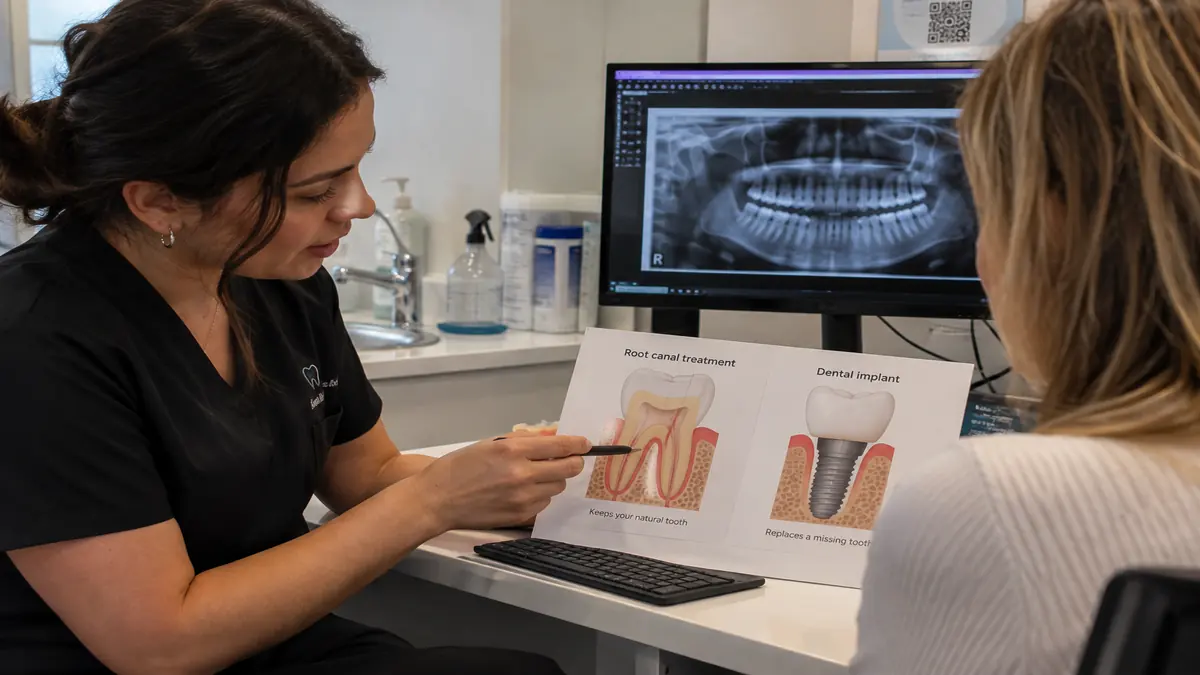

Root canal treatment and dental implants solve different problems. Root canal treatment aims to keep a natural tooth after the pulp inside it has become inflamed, infected or damaged. An implant may replace a tooth after extraction when keeping that tooth is not predictable or appropriate. An implant is not a direct treatment for an infected tooth; extraction comes first.
When comparing root canal vs dental implant, Greensborough patients need to know whether the tooth can be restored, not simply which technology sounds newer. We assess the crack or decay, remaining tooth structure, gum and bone support, neighbouring teeth, symptoms and long-term maintenance. This guide explains the pathways and the questions that shape a decision.
What does root canal treatment do?
Root canal treatment removes inflamed or infected pulp tissue from inside the tooth. The canals are cleaned, shaped and filled, and the tooth is restored so it can continue functioning.
It may be considered when:
- Deep decay has reached or damaged the pulp
- A tooth has been injured
- The pulp has died
- Infection is present around the root
- Repeated dental work has affected the pulp
- Symptoms and tests support the diagnosis
What does an implant pathway involve?
An implant is placed into the jaw to support a crown or bridge after a tooth is missing. The pathway may involve extraction, healing, implant surgery, integration with bone and restoration.
Possible stages include:
- diagnosis and extraction planning
- tooth removal
- management of infection and the socket
- bone grafting where indicated
- implant placement at an appropriate time
- healing and osseointegration
- impressions or scanning
- attachment of the final restoration
- ongoing cleaning and review
Some stages can occur together in selected cases, but “immediate” treatment is not suitable for every site.
The central question: can the natural tooth be restored?
Preserving a natural tooth is generally considered when it can be treated and restored with a reasonable prognosis. Extraction is irreversible and creates a replacement decision.
Factors that may make a tooth difficult or impossible to restore include:
- A vertical root fracture
- Decay extending too far below the gum or bone
- Insufficient sound tooth structure
- Severe periodontal bone loss
- Unfavourable root anatomy or resorption
- Repeated treatment with persistent disease
- A fracture pattern that cannot be predictably restored
None of these should be diagnosed from symptoms or an online image. Examination, testing and appropriate radiographs are required, and specialist opinions may be helpful in complex cases.
Comparing the pathways
The table below introduces practical differences without declaring one option better for every person.
| Question | Root canal and restoration | Extraction and implant |
| Main aim | Keep the natural tooth | Replace a missing tooth |
| Surgery | Often no extraction surgery | Extraction and implant surgery involved |
| Treatment length | Commonly staged across appointments | Often includes months of healing |
| Bone | Retaining the root can preserve the site | Bone quantity and healing affect placement |
| Final restoration | Filling, onlay or crown depending on tooth | Implant-supported crown or bridge |
| Main limitations | Tooth may fracture, or infection may persist/recur | Integration, gum, bone and component complications |
| Maintenance | Cleaning and dental reviews | Cleaning, gum monitoring and component reviews |
The decision also considers personal priorities, health, cost factors and willingness to undergo surgery.
Pain is not enough to choose
Severe pain can occur with pulp inflammation, infection, cracks or other conditions. Conversely, a badly damaged pulp may stop producing pain. Symptoms alone do not establish whether the tooth can be saved.
Dental assessment may involve:
- history of the pain and triggers
- examination for decay, cracks and swelling
- tapping and biting tests
- pulp sensibility tests
- gum measurements
- radiographs
- removal of an old restoration in selected cases
If there is facial swelling, fever, difficulty swallowing or breathing, or rapidly worsening illness, seek urgent care. Healthdirect guides dental abscesses and urgent symptoms.
Cracks change the discussion
A crack limited to the crown of a tooth may sometimes be restored. A crack extending deeply or vertically through the root can make retention unsuitable. Crack location is not always visible from the outside.
Root canal treatment addresses tissue inside the tooth; it does not glue a split root back together. The planned final restoration must also protect the remaining structure where possible.
This is why a painful cracked tooth may require staged assessment. We should not promise root canal treatment before knowing whether the tooth can support a restoration.
What happens after root canal treatment?
The tooth needs a durable coronal seal and restoration. Back teeth often require cuspal coverage because they carry substantial chewing force, while the appropriate restoration for a front tooth depends on remaining structure and appearance.
Our root canal aftercare guide explains temporary tenderness, eating, cleaning and when to call. Completing the final restoration at the recommended time is important; a temporary filling is not intended as the long-term endpoint.
Root-treated teeth still need brushing, interdental cleaning and examinations. They can develop decay and gum disease even though the pulp has been removed.
What happens after extraction?
Extraction removes the tooth and begins socket healing. Replacement may be immediate, early or delayed depending on infection, bone, gum and implant stability.
Temporary tooth options vary with location and circumstances. Bone grafting may be considered when site shape is inadequate, but it carries its own stages and uncertainties.
Our guide to dental implant healing stages in Greensborough explains why surface healing and bone integration are separate milestones.
Does an implant last longer than a root-treated tooth?
No individual lifetime can be guaranteed for either. Studies can report group outcomes, but they do not predict a particular tooth or implant.
Longevity is influenced by:
- initial diagnosis and case selection
- quality and amount of tooth structure
- periodontal and bone support
- restoration design
- bite and grinding
- plaque control
- smoking and health factors
- attendance for maintenance
- accidents and future disease
The relevant comparison is between the prognosis of this tooth and the risks and demands of replacing it.
What are the risks?
Root canal treatment may not resolve infection, canals may be difficult to treat, instruments can separate, the tooth can fracture, and retreatment or surgery may later be considered. The restoration can also fail or decay.
Implant treatment can involve infection, failure to integrate, tissue recession, bone loss, altered sensation, graft complications and mechanical problems with the crown or components. Surgery and healing time are additional considerations.
An informed decision includes the risks of doing nothing. Untreated infection or a non-restorable tooth may cause recurring pain, swelling and damage, but urgency should still be described accurately rather than used as sales pressure.
When should an endodontist or another specialist be involved?
An endodontist is a dentist with specialist training in root canal treatment. Referral may be considered for complex anatomy, retreatment, difficult diagnosis, dental trauma or other challenging cases.
Implant planning may involve a dentist with relevant training, a periodontist, oral surgeon, prosthodontist or other clinician depending on complexity. Seeking a specialist opinion does not mean treatment will necessarily become more extensive; it can clarify whether retention is realistic.
What changes the cost?
We do not publish a generic price because scope differs. Root canal cost factors include tooth type, complexity, retreatment, specialist involvement and the final restoration. Implant factors include extraction, grafting, imaging, implant components, temporary teeth and the final crown.
Compare complete pathways rather than one appointment. A root canal quote without the required crown and an implant quote without extraction or grafting are not equivalent.
Questions to ask before deciding
For a root canal vs dental implant Greensborough assessment, ask:
- Is the tooth restorable?
- Is a crack suspected, and where?
- What is the periodontal support?
- Would specialist assessment change the decision?
- What restoration will the tooth need after root canal treatment?
- If extracted, must the site heal before implant placement?
- Might grafting be required?
- What alternatives include a bridge or leaving the space?
- What are the main risks for me?
- What maintenance follows each option?
The clinician should be able to explain why the recommended pathway fits the findings.
Have the tooth assessed before choosing a replacement
The root canal vs dental implant Greensborough decision begins with whether the natural tooth can be predictably restored. G Dental is located at 137 Grimshaw Street, Greensborough, and same-day appointments may be available within opening hours for urgent dental concerns.
Call us on (03) 9435 6063 or read about root canal therapy and dental implants. We will explain the diagnosis, reasonable alternatives and complete treatment stages before you decide.
Frequently asked questions
1. Is extraction quicker than root canal treatment?
Extraction removes the tooth, but replacement may add surgery and months of healing. “Quicker” depends on whether the comparison ends at tooth removal or includes restoring the space.
2. Can infection return after a root canal?
Persistent or recurrent disease can occur. Assessment may consider retreatment, endodontic surgery or extraction depending on the cause and tooth.
3. Can an implant be placed on the same day as extraction?
Sometimes, where site conditions and stability are suitable. It should not be promised before clinical and radiographic assessment.
4. Is an implant better than a natural tooth?
An implant is a useful replacement for a missing tooth, not an upgrade automatically preferred to a restorable natural tooth.
5. What if I do nothing?
The consequences depend on the diagnosis. Ask about monitoring, symptom risk, infection and changes that may make later treatment more difficult.

